Sunday, August 4, 2013

A business (also known as enterprise or firm) is an organization involved in the tradeof goods, services, or both to consumers.[1] Businesses are predominant in capitalisteconomies, where most of them are privately owned and administered to provide service to its customers. Businesses may also be not-for-profit or state-owned. A business owned by multiple individuals may be referred to as a company, although that term also has a more precise meaning.

The etymology of "business" relates to the state of being busy either as an individual or society, as a whole, doing commercially viable and profitable work. The term "business" has at least three usages, depending on the scope — the singular usage to mean a particular organization; the generalized usage to refer to a particular market sector, "the music business" and compound forms such as agribusiness; and the broadest meaning, which encompasses all activity by the community of suppliers of goods and services. However, the exact definition of business, like much else in the philosophy of business, is a matter of debate and complexity of meanings.


Basic forms of ownership[edit source | editbeta]

Although forms of business ownership vary by jurisdiction, several common forms exist:
Sole proprietorship: A sole proprietorship is a business owned by one person for-profit. The owner may operate the business alone or may employ others. The owner of the business has unlimited liability for the debts incurred by the business.
Partnership: A partnership is a business owned by two or more people. In most forms of partnerships, each partner has unlimited liability for the debts incurred by the business. The three typical classifications of for-profit partnerships are general partnerships,limited partnerships, and limited liability partnerships.
Corporation: A corporation is a limited liability business that has a separate legal personality from its members. Corporations can be either government-owned or privately owned, and corporations can organize either for-profit or not-for-profit. A privately owned, for-profit corporation is owned by shareholders who elect a board of directors to direct the corporation and hire its managerial staff. A privately owned, for-profit corporation can be either privately held or publicly held.
Cooperative: Often referred to as a "co-op", a cooperative is a limited liability business that can organize for-profit or not-for-profit. A cooperative differs from a for-profit corporation in that it has members, as opposed to shareholders, who share decision-making authority. Cooperatives are typically classified as either consumer cooperatives or worker cooperatives. Cooperatives are fundamental to the ideology of economic democracy.
Classifications[edit source | editbeta]
Agriculture and mining businesses are concerned with the production of raw material, such as plants or minerals.
Financial businesses include banks and other companies that generate profit through investment and management of capital.
Information businesses generate profits primarily from the resale of intellectual property and include movie studios, publishers and packaged software companies.
Manufacturers produce products, from raw materials or component parts, which they then sell at a profit. Companies that make physical goods, such as cars or pipes, are considered manufacturers.
Real estate businesses generate profit from the selling, renting, and development of properties comprising land, residential homes, and other kinds of buildings.
Retailers and distributors act as middle-men in getting goods produced by manufacturers to the intended consumer, generating a profit as a result of providing sales or distribution services. Most consumer-oriented stores and catalog companies are distributors or retailers.
Service businesses offer intangible goods or services and typically generate a profit by charging for labor or other services provided to government, other businesses, or consumers. Organizations ranging from house decorators to consulting firms, restaurants, and even entertainers are types of service businesses.
Transportation businesses deliver goods and individuals from location to location, generating a profit on the transportation costs.
Utilities produce public services such as electricity or sewage treatment, usually under a government charter.

There are many other divisions and subdivisions of businesses. The authoritative list of business types for North America is generally considered to be the North American Industry Classification System, or NAICS. The equivalent European Union list is the Statistical Classification of Economic Activities in the European Community (NACE).
Management[edit source | editbeta]
Main article: Management

The efficient and effective operation of a business, and study of this subject, is called management. The major branches of management are financial management, marketing management, human resource management, strategic management, production management,operations management, service management and information technology management.[citation needed]

Owners engage in business administration either directly or indirectly through the employment of managers. Owner managers, or hired managers administer to three component resources that constitute the business' value or worth: financial resources, capital or tangible resources, and human resources. These resources are administered to in at least five functional areas: legal contracting, manufacturing or service production, marketing, accounting, financing, and human resourcing.[citation needed]
Reforming state enterprises[edit source | editbeta]

In recent decades, assets and enterprises that were run by various states have been modeled after business enterprises. In 2003, thePeople's Republic of China reformed 80% of its state-owned enterprises and modeled them on a company-type management system.[2]Many state institutions and enterprises in China and Russia have been transformed into joint-stock companies, with part of their shares being listed on public stock markets.

Business process management (BPM) is a holistic management approach[1] focused on aligning all aspects of an organization with the wants and needs of clients. It promotes business effectiveness and efficiency while striving for innovation, flexibility, and integration with technology. BPM attempts to improve processes continuously. It can therefore be described as a "process optimization process." It is argued that BPM enables organizations to be more efficient, more effective and more capable of change than a functionally focused, traditional hierarchical management approach.
Organization and government regulation[edit source | editbeta]
See also: Theory of the firm

Most legal jurisdictions specify the forms of ownership that a business can take, creating a body of commercial law for each type.

The major factors affecting how a business is organized are usually:
The size and scope of the business firm and its structure, management, and ownership, broadly analyzed in the theory of the firm. Generally a smaller business is more flexible, while larger businesses, or those with wider ownership or more formal structures, will usually tend to be organized as corporations or (less often) partnerships. In addition, a business that wishes to raise money on a stock market or to be owned by a wide range of people will often be required to adopt a specific legal form to do so.
The sector and country. Private profit-making businesses are different from government-owned bodies. In some countries, certain businesses are legally obliged to be organized in certain ways.
Limited Liability Companies (LLC), limited liability partnerships, and other specific types of business organization protect their owners or shareholders from business failure by doing business under a separate legal entity with certain legal protections. In contrast, unincorporated businesses or persons working on their own are usually not so protected.
Tax advantages. Different structures are treated differently in tax law, and may have advantages for this reason.
Disclosure and compliance requirements. Different business structures may be required to make less or more information public (or report it to relevant authorities), and may be bound to comply with different rules and regulations.

Many businesses are operated through a separate entity such as a corporation or a partnership (either formed with or without limited liability). Most legal jurisdictions allow people to organize such an entity by filing certain charter documents with the relevant Secretary of State or equivalent and complying with certain other ongoing obligations. The relationships and legal rights of shareholders, limited partners, or members are governed partly by the charter documents and partly by the law of the jurisdiction where the entity is organized. Generally speaking, shareholders in a corporation, limited partners in a limited partnership, and members in a limited liability company are shielded from personal liability for the debts and obligations of the entity, which is legally treated as a separate "person". This means that unless there is misconduct, the owner's own possessions are strongly protected in law if the business does not succeed.

Film producer


Film rights[edit source | editbeta]

During the "discovery stage" the producer has to find and acknowledge promising material.[6] Often a producer must then retrieve thefilm rights or an option.[7] If the rights owner is worried about preserving the integrity, voice and vision of his/her work, the producer might have to comply with a variety of demands concerning the screenplay, the film director, the casts or other topics. [8] Thus it takes occasionally a lot of time and effort before the actual pre-production can begin. Late German producer Bernd Eichinger is said to have worked 15 years on convincing novelist Patrick Süskind just to agree to a film adaptation of his book Perfume.[9] However, sometimes all effort is futile. J. D. Salinger, for example, refused all film producers as long as he lived.[10]
Pre-production[edit source | editbeta]

Unless the film is supposed to be based on an original script, the producer has to find an appropriate screenwriter.[11][12] If an existing script is considered flawed, they are able to order a new version or make the decision to hire a script doctor.[13] [14] [15] The producer also has the final say on which film director gets hired.[16] [17] They also have the last word when it comes to casting questions. [18]
Production[edit source | editbeta]

Producers can't always personally supervise all parts of their production. The reasons are many. For example some producers run a company which also deals with film distribution. [19] [20] Also cast and film crew often work at different times and places and certain films even require a second unit. Consequently it is normal that the main producer will appoint executive producers, line producers orunit production managers who represent the main producer's interests. [21] The executive producer for Star Wars Episode IV: A New Hope, Star Wars Episode V: The Empire Strikes Back and Star Wars Episode VI: Return of the Jedi was George Lucas himself, the creator of the Star Wars Universe. [22]
Whether the person credited as "producer" or a person credited as "executive producer" has more input on a production is not always clear and is subject to change as the film is substantiated. Since filmmaking is a dynamic process, responsibilities can grow or shift in the process and to-be credits for producers can get adjusted retroactively. For example somebody hired as "line producer" might later be credited as "executive producer".
Because of these dynamics it is imperative that all involved producers agree on production standards right from the start. It is said that negligence in that matter can lead to a domino effect. [23]
Post-production[edit source | editbeta]

Among other things the producer has the last word on whether sounds or music have to be changed or scenes have to be looped. But even if the shooting has officially been finished, the producers can still demand that additional scenes are filmed after all. In case of a negative test screening producers might even demand and get an alternative film ending. This happened for example with First Blood.[24] Producers are also in charge of selling the film or arranging distribution rights.
Becoming a film producer[edit source | editbeta]
“ From the first draft script, through all stages of production, to the final dub, success or failure rests largely in the hands of the producer. Experience in this field does not come overnight. Rather it is born out of long years of creative and technical know-how, and above all a love for the job and all that goes with it, together with the ability to choose the right talent with which to surround himself. ”

— Julian Wintle, [25]


There are different ways to become a film producer. Stanley Kramer started as editor and writer.[26] Other producers started as actor or director.


Film schools offer degree courses that include film production knowledge.[27] [28] Some courses are especially designed for future film producers, focusing on key topics like pitching, script development, script assessment, shooting schedule design and budgeting.[29][30] [6] [3] The students can also expect practical training in regards to post-production..[31]


On the occasion of announcing his own film school "L’Ecole de la Cite" film producer Luc Besson admitted that at the beginning of his career he would have appreciated the chance to attend a film school.[32]
PGA[edit source | editbeta]

In November 2012, three studios: Universal Pictures, 20th Century Fox and Columbia Pictures plus Screen Gems joined DreamWorks Animation and the Weinstein Company in Producers Guild of America certification program which designates those producers that request it "p.g.a." after their name if a genuine producer.[21]

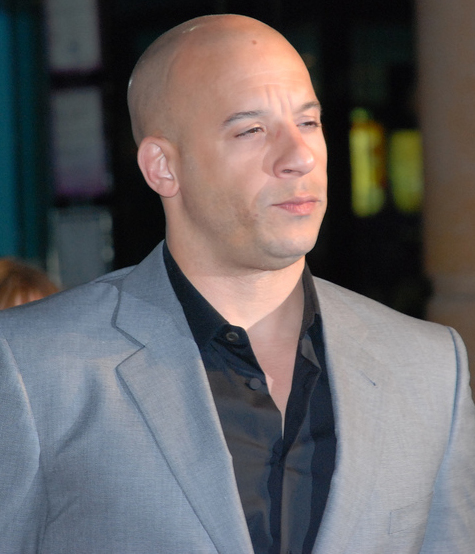
Vin Diesel


Diesel was born in New York City, New York. His mother, Delora Sherleen (Sinclair) Vincent, is an astrologer.[2][3] Diesel has stated that he is "of ambiguous ethnicity", with his background including Scottish, Italian, and "a lot of stuff",[4][5] and that he is "definitely a person of colour".[6] He has never met his biological father, and has said that "all I know from my mother is that I have connections to many different cultures".[6] He was raised by his Caucasian mother and African-American stepfather, Irving H. Vincent, an acting instructor and theater manager.[6][7][8] He made his stage debut at age seven when he appeared in the children's play Dinosaur Door, written by Barbara Garson. The play was produced at Theater for the New City in New York's Greenwich Village. His involvement in the play came about when he, his brother, and some friends had broken into Theater for the New City's space on Jane Street with the intent to vandalize it. They were confronted by the theater's artistic director, Crystal Field, who, instead of calling the police, handed them scripts and offered them parts in the upcoming show.[9][10][11]


Diesel remained involved with the theater throughout adolescence, going on to attend the city's Hunter College, where his creative writing studies led him to begin screenwriting. He has identified himself as a "multi-faceted" actor[12] as a result of early difficulties finding roles due to his mixed heritage.[12][13] He changed his name to Vin Diesel while working as a bouncer at the New York nightclubTunnel, because one's real name is not usually given out in that business. The name "Vin" is simply a shortened version of "Vincent". He received the nickname "Diesel" from his friends, who said he ran off diesel fuel, referring to his non-stop energy.
Career
1990s

Diesel's first film role was a brief uncredited appearance in the film Awakenings (1990). He then wrote, directed, produced, and starred in the short film Multi-Facial (1994), a short semi-autobiographical film which follows a struggling actor stuck in the audition process. The film was selected for screening at the 1995 Cannes Festival. He made his first feature-length film, Strays (1997), an urban drama in which he played a gang leader whose love for a woman inspires him to try to change his ways. Written, directed, and produced by Diesel, the film was selected for competition at the 1997 Sundance Festival, leading to an MTV deal to turn it into a series. He was cast in Steven Spielberg's 1998 Oscar-winning film Saving Private Ryan on the poignancy of his performance in Multi-Facial. In 1999, he earned critical acclaim for his voice work as the title character in the animation film The Iron Giant.[14]Diesel had a major role in the business drama Boiler Room (2000),[14] and then got his breakthrough role as the anti-hero Riddick in the science-fiction film Pitch Black (2000).[14]Diesel attained action hero stardom with two box office hits: the street racing action film The Fast and the Furious (2001), and the action thriller xXx (2002).[14] In 2004, Diesel reprised his role as Riddick in The Chronicles of Riddick,[14] which was a box office failure considering the large budget. In 2005, he played a lighthearted role in the comedy film The Pacifier, which became a box office success.[14]

In 2006, he chose a dramatic role playing real-life mobster Jack DiNorscio in Find Me Guilty.[14] Although he received critical acclaim for his performance, the film did poorly at the box office.[14] Later that year, Diesel made a cameo appearance in The Fast and the Furious: Tokyo Drift, reprising his role from The Fast and the Furious. He was originally offered the lead in 2 Fast 2 Furious, but turned it down.[14] He was also offered the chance to reprise his role from xXx in xXx: State of the Union, but turned it down as well.

In 2007, Diesel was set to produce and star as Agent 47 in the film adaptation of the video game Hitman, but eventually pulled back and served as executive producer on the film instead. In 2008, he starred in the science-fiction action thriller Babylon A.D.. Diesel returned to the The Fast and The Furious series, alongside all the actors from the original film, in Fast & Furious, which was released in April 2009.[14]
2010s

In 2011, Diesel returned for Fast Five, the fifth film in the series, and reprised the role again in Fast & Furious 6 (2013). He will star inRiddick, slated for release in September 2013. In April 2013, Diesel announced that Fast & Furious 7 would be released in July 2014, with production scheduled to begin in August 2013.[15] In July 2013, Diesel announced that he had accepted a role in a Marvel Studiosfilm; the role has not been revealed, but speculation points to Guardians of the Galaxy or The Avengers: Age of Ultron. It is rumored that he might voice Rocket Raccoon in Guardians and possibly Thanos in both Guardians/Avengers 2 or possibly Vision or Ultron in Avengers 2.
Personal life

Diesel is noted for his recognizably deep voice; he has said that his voice broke at around age 15, giving him a mature sounding voice on the telephone.[16] He has a twin brother, Paul, a younger brother, Tim, and a sister, Samantha.[14] Around 2001, Diesel dated hisFast and the Furious co-star, Michelle Rodriguez.[17]

Diesel has a daughter, Hania Riley (born 2008), with his girlfriend, Mexican model Paloma Jimenez.[18][19] Speaking to An tEolas, an Irish newspaper, Diesel stated he has been seen as a hard man, but is in touch with his soft side as a father.[20] Diesel claims that he prefers dating in Europe, where he is less likely to be recognized and where celebrities are not romantically linked to each other. He prefers to maintain his privacy regarding his personal life: "I'm not gonna put it out there on a magazine cover like some other actors. I come from the Harrison Ford, Marlon Brando, Robert De Niro, Al Pacino code of silence."[21]

Diesel has expressed his love for the Dominican Republic, and how he relates to its multicultural facets.[22] He is also acquainted with its president, Leonel Fernández, and appeared in one of Fernández's earlier campaign ads. Los Bandoleros, a short film directed by Diesel, was also filmed in the Dominican Republic.[23] Diesel has played Dungeons & Dragons for over 20 years,[24] and wrote the foreword for the commemorative book 30 Years of Adventure: A Celebration of Dungeons & Dragons. In the 30th anniversary issue ofDragon Magazine, it was revealed that Diesel had a fake tattoo of his character's name, Melkor, on his stomach while filming xXx.

Film director


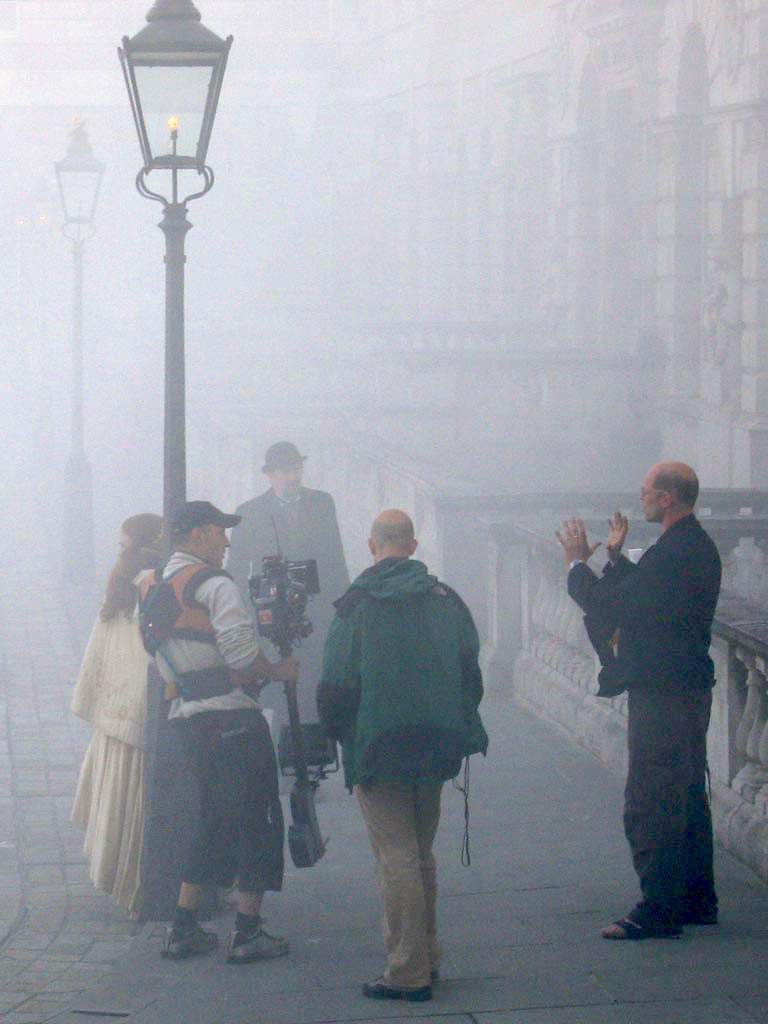
Film directors create an overall vision through which a film eventually becomes realized.[2]Realizing this vision includes overseeing the artistic and technical elements of film production, as well as directing the shooting timetable and meeting deadlines.[3] This entails organizing the film crew in such a way as to achieve his or her vision of the film.[4] [5] This requires skills of group leadership, as well as the ability to maintain a singular focus even in the stressful environment of a film set..[6] Moreover it is necessary to have an artistic eye to frame shots and to give precise feedback to cast and crew,[7] thus, excellent communication skills are a must.[8] Since the film director depends on the successful cooperation of many different creative individuals with possibly strongly contradicting artistic ideals and visions, he or she also needs to possess conflict resolution skills in order mediate whenever necessary .[9] Thus the director ensures that all individuals involved in the film production are working towards an identical vision for the completed film.[4] The set of varying challenges he or she has to tackle has been described as "a multi-dimensional jigsaw puzzle with egos and weather thrown in for good measure".[10] It adds to the pressure that the success of a film can influence when and how they will work again. [11] Omnipresent are the boundaries of the films budget.[12] Additionally, the director may also have to ensure an intended age rating.[13] Theoretically the sole superior of a director is the studio that is financing the film,[14] [2] however a poor working relationship between a film director and an actor could possibly result in the director being replaced if the actor is a major film star.[15] Even so, it is arguable that the director spends more time on a project than anyone else, considering that the director is one of the few positions that requires intimate involvement during every stage of film production. Thus, the position of film director is widely considered to be a highly stressful and demanding one.[1] It has been said that "20-hour days are not unusual".[2]


Some film directors started as screenwriters, film editors or actors.[16] Other film directors have visited a film school to "get formal training and education in their craft". [17] Film students generally study the basic skills utilized in making a film. [18] This includes, for example, preparation, shot lists and storyboards, blocking, protocols of dealing with professional actors, and reading scripts.[19] Some film schools are equipped with sound stages and post-production facilities[20] Besides basic technical and logistical skills, students also receive education on the nature of professional relationships that occur during film production.[21] A full degree course can be designed for up to five years of studying.[22] Future directors usually complete short films during their enrolment.[1] The National Film School of Denmark has the student's final projects presented on national TV. [23] Some film schools retain the rights for their students' works.[24] Many directors successfully prepared for making feature films by working in television.[25] The German Film and Television Academy Berlin consequently cooperates with the Berlin/Brandenburg TV station RBB (Berlin-Brandenburg Broadcasting) andARTE.[26]


Different directors can vary immensely amongst themselves, under various characteristics. Several examples

Movie


A film, also called a movie or motion picture, is a series of still images which, when shown on a screen, creates the illusion of moving images. A film is created by photographing actual scenes with a motion picture camera; by photographing drawings or miniature models using traditionalanimation techniques; by means of CGI and computer animation; or by a combination of some or all of these techniques and other visual effects. The process of filmmaking is both an art and anindustry. Films were originally recorded onto plastic film which was shown through a movie projector onto a large screen; more modern techniques may use wholly digital filming and storage, such as the Red One camera which records onto hard-disk or flash cards.

Films usually include an optical soundtrack, which is a graphic recording of the spoken words, music and other sounds that are to accompany the images. It runs along a portion of the film exclusively reserved for it and is not projected.

Films are cultural artifacts created by specific cultures. They reflect those cultures, and, in turn, affect them. Film is considered to be an important art form, a source of popular entertainment, and a powerful medium for educating—or indoctrinating—citizens. The visual basis of film gives it a universal power of communication. Some films have become popular worldwide attractions by using dubbing or subtitles to translate the dialog into the language of the viewer.

The individual images that make up a film are called frames. During projection, a rotating shutter causes intervals of darkness as each frame in turn is moved into position to be projected, but the viewer does not notice the interruptions because of an effect known as persistence of vision, whereby the eye retains a visual image for a fraction of a second after the source has been removed. The perception of motion is due to a psychological effect called beta movement.

The name "film" originates from the fact that photographic film (also called film stock) has historically been the medium for recording and displaying motion pictures. Many other terms exist for an individual motion picture, including picture, picture show, moving picture,photoplay and flick. The most common term in the United States is movie, while in Europe film is preferred. Terms for the field in general include the big screen, the silver screen, the movies and cinema; the latter is commonly used in scholarly texts and critical essays, especially by European writers. In early years, the word sheet was sometimes used instead of screen.


Preceding film in origin by thousands of years, early plays and dances had elements common to film: scripts, sets, costumes, production, direction, actors, audiences,storyboards, and scores. Much terminology later used in film theory and criticism apply, such as mise en scene (roughly, the entire visual picture at any one time). Owing to the lack of any technology for doing so, the moving images and sounds could not be recorded for replaying as with film.

In the mid-19th century, inventions such as the phenakistoscope and zoetrope demonstrated that a carefully designed sequence of drawings, showing phases of the changing appearance of objects in motion, would appear to show the objects actually moving if they were displayed one after the other at a sufficiently rapid rate. These devices relied on the phenomenon of persistence of vision to make the display appear continuous even though the observer's view was actually blocked as each drawing rotated into the location where its predecessor had just been glimpsed. Each sequence was limited to a small number of drawings, usually twelve, so it could only show endlessly repeating cyclical motions. By the late 1880s, the last major device of this type, the praxinoscope, had been elaborated into a form that employed a long coiled band containing hundreds of images painted on glass and used the elements of a magic lantern to project them onto a screen.

The use of sequences of photographs in such devices was initially limited to a few experiments with subjects photographed in a series of poses, because the available emulsions were not sensitive enough to allow the short exposures needed to photograph subjects that were actually moving. The sensitivity was gradually improved and in the late 1870s Eadweard Muybridge created the first animated image sequences photographed in real-time. A row of cameras was used, each in turn capturing one image on a glass photographic plate, so the total number of images in each sequence was limited by the number of cameras, about two dozen at most. Muybridge used his system to analyze the movements of a wide variety of animal and human subjects. Hand-painted images based on the photographs were projected as moving images by means of his zoopraxiscope.[1]


By the end of the 1880s, the introduction of lengths of celluloid photographic film and the invention of motion picture cameras, which could photograph an indefinitely long rapid sequence of images using only one lens, allowed several minutes of action to be captured and stored on a single compact reel of film. Some early films were made to be viewed by one person at a time through a "peep show" device such as the Kinetoscope. Others were intended for a projector, mechanically similar to the camera and sometimes actually the same machine, which was used to shine an intense light through the processed and printed film and into a projection lens so that these "moving pictures" could be shown tremendously enlarged on a screen for viewing by an entire audience. The first public exhibition of projected motion pictures in America was at Koster and Bial's Music Hall in New York City on the 23rd of April 1896.


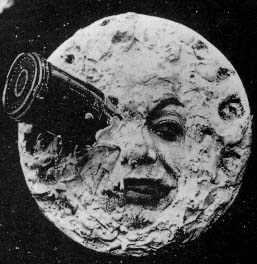
The earliest films were simply one static shot that showed an event or action with no editingor other cinematic techniques. Around the turn of the 20th century, films started stringing several scenes together to tell a story. The scenes were later broken up into multiple shots photographed from different distances and angles. Other techniques such as camera movement were developed as effective ways to tell a story with film. Until sound film became commercially practical in the late 1920s, motion pictures were a purely visual art, but these innovative silent films had gained a hold on the public imagination. Rather than leave audiences with only the noise of the projector as an accompaniment, theater owners hired a pianist or organist or, in large urban theaters, a full orchestra to play music that fit the mood of the film at any given moment. By the early 1920s, most films came with a prepared list of sheet music to be used for this purpose, and complete film scores were composed for major productions.

The rise of European cinema was interrupted by the outbreak of World War I, while the film industry in the United States flourished with the rise of Hollywood, typified most prominently by the innovative work of D. W. Griffith in The Birth of a Nation (1915) and Intolerance (1916). However, in the 1920s, European filmmakers such as Sergei Eisenstein, F. W. Murnau andFritz Lang, in many ways inspired by the meteoric wartime progress of film through Griffith, along with the contributions of Charles Chaplin, Buster Keaton and others, quickly caught up with American film-making and continued to further advance the medium.

In the 1920s, the development of electronic sound recording technologies made it practical to incorporate a soundtrack of speech, music and sound effects synchronized with the action on the screen.[citation needed] The resulting sound films were initially distinguished from the usual silent "moving pictures" or "movies" by calling them "talking pictures" or "talkies."[citation needed] The revolution they wrought was swift. By 1930, silent film was practically extinct in the US and already being referred to as "the old medium."[citation needed]

Another major technological development was the introduction of "natural color," which meant color that was photographically recorded from nature rather than added to black-and-white prints by hand-coloring, stencil-coloring or other arbitrary procedures, although the earliest processes typically yielded colors which were far from "natural" in appearance.[citation needed] While the advent of sound films quickly made silent films and theater musicians obsolete, color replaced black-and-white much more gradually.[citation needed] The pivotal innovation was the introduction of the three-strip version of the Technicolor process, first used for animated cartoons in 1932, then also for live-action short films and isolated sequences in a few feature films, then for an entire feature film, Becky Sharp, in 1935. The expense of the process was daunting, but favorable public response in the form of increased box office receipts usually justified the added cost. The number of films made in color slowly increased year after year.

In the early 1950s, the proliferation of black-and-white television started seriously depressing North American theater attendance.[citation needed] In an attempt to lure audiences back into theaters, bigger screens were installed, widescreen processes,polarized 3D projection and stereophonic sound were introduced, and more films were made in color, which soon became the rule rather than the exception. Some important mainstream Hollywood films were still being made in black-and-white as late as the mid-1960s, but they marked the end of an era. Color television receivers had been available in the US since the mid-1950s, but at first they were very expensive and few broadcasts were in color. During the 1960s, prices gradually came down, color broadcasts became common, and sales boomed. The overwhelming public verdict in favor of color was clear. After the final flurry of black-and-white films had been released in mid-decade, all Hollywood studio productions were filmed in color, with rare exceptions reluctantly made only at the insistence of "star" directors such as Peter Bogdanovich and Martin Scorsese.[citation needed]

The decades following the decline of the studio system in the 1960s saw changes in the production and style of film. Various New Wave movements (including the French New Wave, Indian New Wave, Japanese New Wave and New Hollywood) and the rise of film-school-educated independent filmmakers contributed to the changes the medium experienced in the latter half of the 20th century.[citation needed] Digital technology has been the driving force for change throughout the 1990s and into the 2000s. Digital 3D projection largely replaced earlier problem-prone 3D film systems and has become popular in the early 2010s.[citation needed]